
Why can’t we build structures that last for centuries?
My genealogical records show our Rochon family tree goes back to at least 1639 to Saint-Cosme-de-Vair in the Perth region southwest of Paris. That inspired me to start my historical fiction novel there on a poor peasant farm. The parish church is central to the story. Église Saint-Côme et Saint-Damien is one of four churches in the area in 1650 and served about 400 parishioners.
The marble high-altar was installed in 1646 when my ancestors were parishioners.

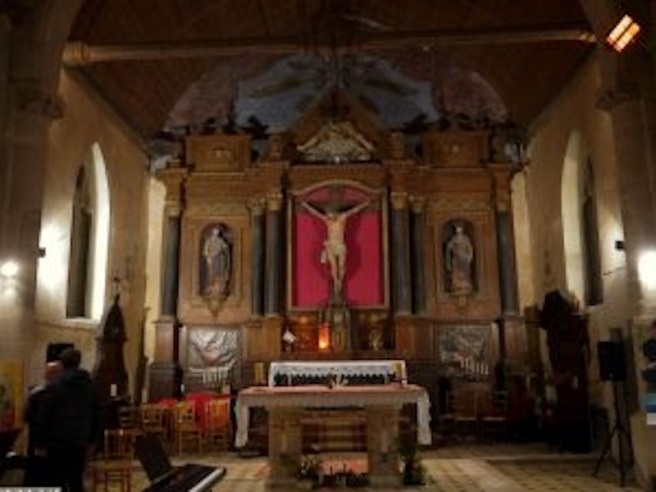
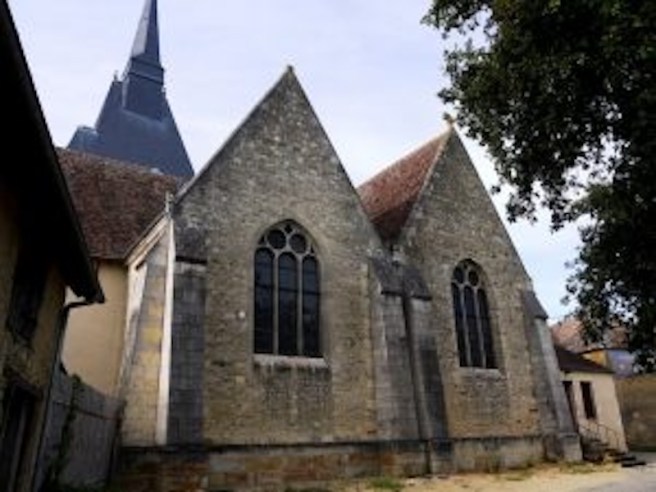
The church dates back to the late 11th century and even further back as attested to by the discovery of a Merovingian sarcophagi beneath the church. After the fall of the Roman Empire, the Merovingians established the largest realm in Western Europe. King Clovis I (481-511) united the Frankish tribes and converted to Catholic Christianity. Merovingian rule ended in 751 but the religious tradition continued until present day.
Fun fact: Merovingian kings were known as “long-haired kings.” It was a symbol of their right to rule, and any Merovingian who cut their hair was not fit to be king.
Fact #2: After uniting the Frankish tribes, the kings had a habit of dividing up land equally among their heirs. This led to disunity and war among them. It also led to feudalism and then to the seigneurial system which tenant farmers labored under in 1650 until the revolution.
Eglise Saint-Côme et Saint Damien was expanded in 1824 and is still in use today.
Why can’t we build things that last that long??
Follow me as my research continues and my novel progresses.
http://www.jeannemeeks.com and on Facebook: https://www.facebook.com/groups/1185865059974956


 Jeanne Meeks ~ Fiction Author
In the U.S. currently the best paint on bricks last up to 20 years. Pictographs on rock walls in the Boundary Waters painted by the Chippewa are estimated to be 500-1,000 years old according to the U.S. Forest Service.
LikeLike
I’d love to visit the Boundary Waters… it is still on my bucket list…especially the pictographs. Some day.
LikeLike