
These nasty looking things are black walnuts. (From experience, I can tell you a patch of them fallen on the bike path can be treacherous!)
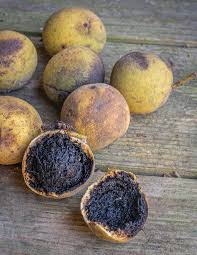
Black walnut trees (Juglans nigra) are native to the Midwest. Squirrels love the nuts and have the teeth to get them open. As a closet forager, I tried to crack a few open with a hammer and by crushing them under my heel. I ended up with my fingers stained black for days…and no nuts.
As I research details for my historical fiction novel set in France in the 17th century, I discovered that walnuts were (and are) a valuable gift of nature. English or Persian walnuts (Juglans regia) were widespread in France and are the nuts we buy in grocery stores. The English version is much easier to crack than our native black walnuts.
In the 17th century, every part of the walnut was used. The meats were dug out and eaten or crushed for oil. The green outer husks, rich in dark tannins, were boiled to make a durable brown ink or fabric dye. Poor families often simmered the husks in iron pots over the hearth until the liquid thickened into a deep sepia stain suitable for marking cloth or coloring wood. The resulting ink darkened as it dried and carried an earthy smell that lingered in the home. The dried shells could be used to lure in squirrels (for the stew pot) or crushed as an abrasive cleaner.
Under the seigneurial system in olden day France, it was illegal for peasants to gather walnuts found on the seigneur’s land, so even simple inks and dyes were often beyond their reach. In my novel, a young girl behind convent walls wishes to send a secret note and devises ink from walnut husks.
It’s amazing what I learn as I research the small details of that time period. If I don’t go down too many rabbit holes, I should have this book completed by December.


My backpacking and canoeing partner had vacation property east of Peoria with native walnut trees that he used to harvest large crops, drying the shells on the pavement, using a cracking device to get at the meat, and give out seasonal bags of walnuts to his friends and relatives.
LikeLiked by 1 person
I really admired his outdoor skills and knowledge.
LikeLike
My Dad’s sister used to go get walnuts in Illinois and shell them for fudge, baking etc. I remember the making a mess outside on their porch.
LikeLiked by 1 person
That’s a lot of work! But I understand they have superior flavor…especially on ice cream. Yum!
LikeLike